
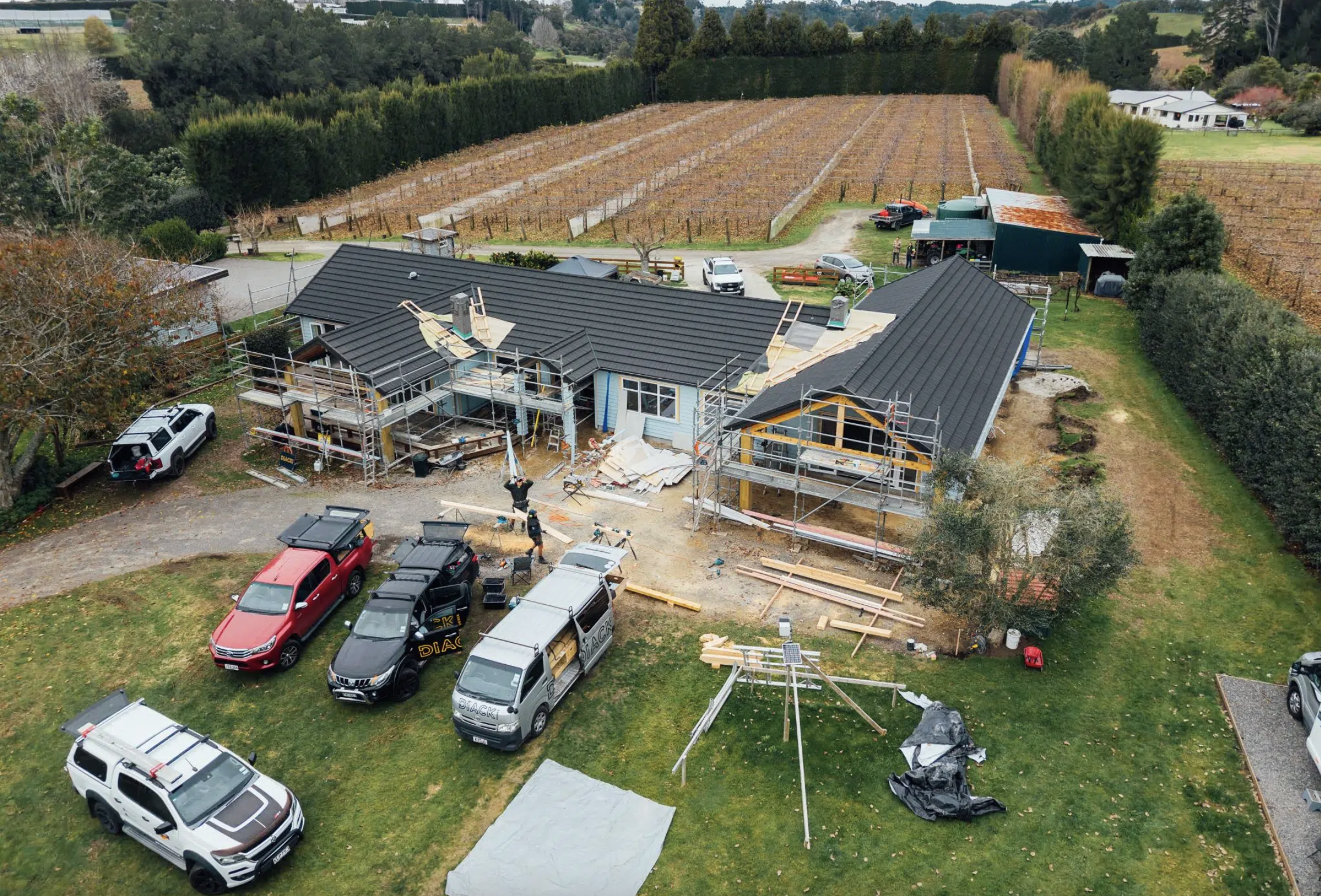
A full home renovation replaces every major system and surface in your house at once. We work on these projects regularly across Tauranga, Papamoa, and Christchurch, and the scope is consistently larger than homeowners expect when they first start planning.
You are dealing with structural work, electrical rewiring, plumbing upgrades, new joinery, fresh cladding, and interior finishes all running in parallel. A large share of the housing stock in these regions dates from the 1950s through the 1990s, and complete overhauls of the 1950s- to 1990s-generation of homes are far more common than room-by-room cosmetic refreshes.
This guide covers everything you need to know before committing to a full renovation: realistic cost ranges, honest timelines, the consenting process, material choices, and the project risks which commonly catch homeowners off guard. If you are weighing up whether to renovate or rebuild, or working out how to stage the work within your budget, the information below provides a clear starting framework for your NZ renovation project.
What does a full home renovation involve?
A full home renovation is not the same as a cosmetic update or a single-room fit-out. This project covers the complete interior and typically a significant portion of the exterior. The work usually includes kitchen and bathroom replacement, a full electrical rewire to current code, new plumbing and drainage, subfloor remediation, re-insulation to current H1 thermal performance standards, new flooring throughout, repainting, and upgraded joinery.
For older homes in Tauranga and Christchurch, the scope frequently expands once walls are opened up. Moisture damage, subfloor rot, undersized wiring, and galvanised water pipes are common findings in homes built before 1990. One of our projects is a clear illustration of this pattern.
What started as a defined full interior renovation uncovered significant moisture damage behind the wall linings, requiring a structural repair programme before the fit-out could proceed. This kind of discovery is not unusual, which is why a thorough pre-construction investigation is non-negotiable for homes of this era.
Understanding the full scope before work starts prevents scope creep, keeps your budget intact, and gives your builder a brief to price accurately.
Our guide on planning custom home construction details how thorough preparation prevents costly delays during construction.
How much does a full home renovation cost in New Zealand?
Cost is the first question every homeowner asks, and is the hardest to answer accurately without a site assessment.
The national average for a full home renovation in New Zealand ranges from $150,000 to $500,000 or more, depending on the home’s size, the condition of the existing structure, the specification level, and your location. In Tauranga and Papamoa, build costs track slightly above the national average due to local demand and labour rates.
Christchurch pricing is broadly similar, with some variation based on consenting timelines and subcontractor availability.
| Renovation scope | Typical NZ cost range | Likely build programme |
|---|---|---|
| Light full renovation (cosmetic refresh, no structural work) | $80,000 to $150,000 | 8 to 14 weeks |
| Mid-range full renovation (kitchen, bathrooms, electrical, insulation) | $150,000 to $300,000 | 16 to 24 weeks |
| Full renovation with structural alterations or additions | $300,000 to $500,000+ | 24 to 40 weeks |
| High-specification or heritage renovation | $400,000 to $700,000+ | 30 to 52 weeks |
These ranges are benchmarks, not quotes. Comparing these figures with custom home construction costs helps homeowners choose the right path for their property. A detailed site inspection, measured drawings, and a specification document are the only way to generate an accurate project budget. If a builder quotes you a firm price without visiting the site, the price will change once work begins.
What are the hidden costs homeowners miss?
The contract price is rarely the final cost on a full renovation. Several cost categories fall outside the main building contract, adding 15 to 25 per cent to the total project expenditure if left unplanned. To prevent stressful budget overruns, homeowners must account for these expenses before physical work begins.
The table below outlines the primary hidden cost categories, realistic budget expectations, and essential planning advice.
| Cost Category | Budget Expectation | Planning Advice |
|---|---|---|
| Council and Consent Fees | $3,000 to $8,000 or more | Varies by project scope. Fees remain non-refundable regardless of building progress. |
| Temporary Accommodation | Varies by local rental rates | Covers four to six months of relocation, storage, and running two households. |
| Project Contingency | 10 to 20 per cent of contract price | Essential for older homes where subfloor remediation or concealed damage exists. |
Homeowners must consider these three critical areas to protect their financial investment:
- Council Regulatory Fees: Tauranga City Council and Christchurch City Council base their processing fees on construction value and the number of inspections.
- Relocation Expenses: Remaining on-site during a major build disrupts daily life, necessitating temporary rentals or storage facilities.
- Concealed Structural Damage: Pre-1990 homes throughout the Bay of Plenty often pose challenges. For example, our Omokoroa Reno project required an immediate contingency draw when subfloor remediation extended beyond the initial visual inspection parameters.
How long does a full home renovation take?
The timeline depends on scope, consenting requirements, the complexity of the existing structure, and how quickly you make decisions during the design and specification phase. The consenting process alone takes six to twelve weeks for a standard residential consent application, and this period runs before construction begins.
Factoring this into your overall programme is critical to setting realistic expectations with your family, your bank, and your builder.
The table below sets out a realistic timeline for a mid-range full renovation of a three-bedroom home in Tauranga or Christchurch.
| Phase | Key activities | Typical duration |
|---|---|---|
| Pre-design | Site assessment, brief development, feasibility check | 2 to 4 weeks |
| Design | Concept drawings, specification, contract pricing | 4 to 8 weeks |
| Consenting | Consent application lodgement and council processing | 6 to 12 weeks |
| Pre-construction | Material procurement, subcontractor scheduling | 2 to 4 weeks |
| Structural and services | Demolition, framing, electrical, plumbing rough-in | 6 to 10 weeks |
| Interior fit-out | Wall linings, kitchen, bathrooms, flooring, painting | 8 to 16 weeks |
| Exterior and final | Cladding, roofing, landscaping, CCC application | 4 to 8 weeks |
Total elapsed time from first site visit to Code Compliance Certificate on a mid-range project runs approximately 32 to 52 weeks. To prevent common schedule issues, review our breakdown of custom home delays and how to manage them. Our project at 54 Milford Park Drive ran to a 38-week programme, matching the pre-construction estimate given the scope involved.
What planning steps do you need to complete before work begins?
Thorough planning before construction begins separates projects that finish on time and on budget from those that experience severe budget blowouts. Skipping or rushing early planning stages transfers cost and delay risks directly to the construction phase, making financial consequences exceptionally difficult to manage.
The pre-construction planning phase requires completing four core areas:
- Scope Definition: Detailing every task, material selection, and project boundary.
- Architectural Design: Finalising floor plans, elevations, and structural details.
- Council Consenting: Securing regulatory approvals from local councils.
- Procurement: Sourcing materials, securing supplier rates, and scheduling subcontractors.
For homes built before 1990, completing a comprehensive condition report is essential. This structural audit must assess these four critical items:
- Moisture Levels: Completing a moisture investigation of wall cavities.
- Subfloor Quality: Reviewing timber framing stability and ground clearance.
- Electrical Safety: Auditing old wiring and power board capacities.
- Plumbing Standards: Checking piping materials and water pressure limits.
Our building teams at Ridge Road and 199 Upland Road completed this structured pre-construction audit before physical work began. In both cases, this upfront assessment identified structural issues early, preventing costly variations and on-site delays.
Do you need a building consent for a full home renovation?
Yes, in almost all cases. Under the New Zealand Building Act 2004, any work that affects the structure of the building, changes the building envelope, or involves new plumbing or electrical connections requires a building consent from the relevant territorial authority.
The Ministry of Business, Innovation and Employment Building Performance website sets out the boundary between exempt and consent-required work clearly, and serves as the authoritative reference before you engage any contractor.
For a full home renovation in Tauranga City or Christchurch City, you will almost certainly need a building consent. Exempt work under Schedule 1 of the Building Act is limited to minor repairs, maintenance, and some defined low-risk alterations. A full renovation touches too many systems to fall within those exemption categories.
Proceeding without consent where consent is required creates serious problems at resale. Unconsented work must be declared to any purchaser, and many banks will decline to lend against properties with unconsented building work. The Consumer NZ website outlines the risks of unconsented work in plain language and is worth reviewing before you commit to any renovation project or sign any contract.
How do you choose the right builder for a full renovation in Tauranga or Christchurch?
A full renovation represents one of the largest financial commitments a homeowner will undertake.
The selected building team will occupy your home for six months or more. For this reason, their project management competency dictates whether your construction timeline holds and your budget remains protected.
To secure a safe building contract and successful renovation, prioritise these three critical requirements when evaluating contractors:
- Industry Credentials and Licensing: Ensure your builder is a Licensed Building Practitioner (LBP) and a registered Master Builder. LBP registration is a legal requirement in New Zealand for restricted building work. Master Builder membership adds essential industry accountability and provides access to structural warranty products if issues arise post-completion. Follow our comprehensive steps on choosing a custom home builder to protect your project.
- Robust Project Management Systems: Ask specifically about their progress tracking, subcontractor management, and client communication methods. A builder who struggles to explain how they coordinate daily logs and schedules carries immense risk, regardless of their cheap pricing.
- Relevant Local Experience: Inspect their completed project portfolio and read client testimonials in detail. Look for successfully completed projects similar in scale, complexity, and age of home to your own property.
What are the biggest risks in a full home renovation, and how do you avoid them?
Full home renovations carry more risk than new builds because homeowners work inside an existing structure, which hides structural defects. Renovations must also operate within the rigid constraints of the existing footprint, orientation, and service connections.
Understanding the three main risk categories is the first step to protecting your investment:
- Concealed Structural or Moisture Damage: Undiscovered defects not found during pre-construction assessments represent the most frequent cause of massive budget blowouts.
- In-Progress Scope Changes: Decisions made by the homeowner during the build, rather than during the design phase, run a close second in driving up costs.
- Contractor Financial Failure: Builder insolvency mid-project is a less common risk but carries the most severe financial and legal consequences.
To eliminate these risks, we implement these direct mitigation strategies:
- Upfront Soil and Framing Audits: A thorough pre-construction investigation reduces the likelihood of discovering hidden moisture or structural damage during construction.
- Fixed-Price Contracts: A fully scoped specification with a documented variation protocol controls decision-driven cost growth.
- Registered Industry Accountability: Working with a builder who carries appropriate liability insurance and belongs to a recognised industry body reduces exposure to contractor failure.
- Client Reference Checks: Ask for references specifically from past clients whose renovations uncovered problems mid-build. This reveals a building team’s true problem-solving capability rather than a polished sales pitch.
What materials should you choose for a full home renovation in New Zealand?
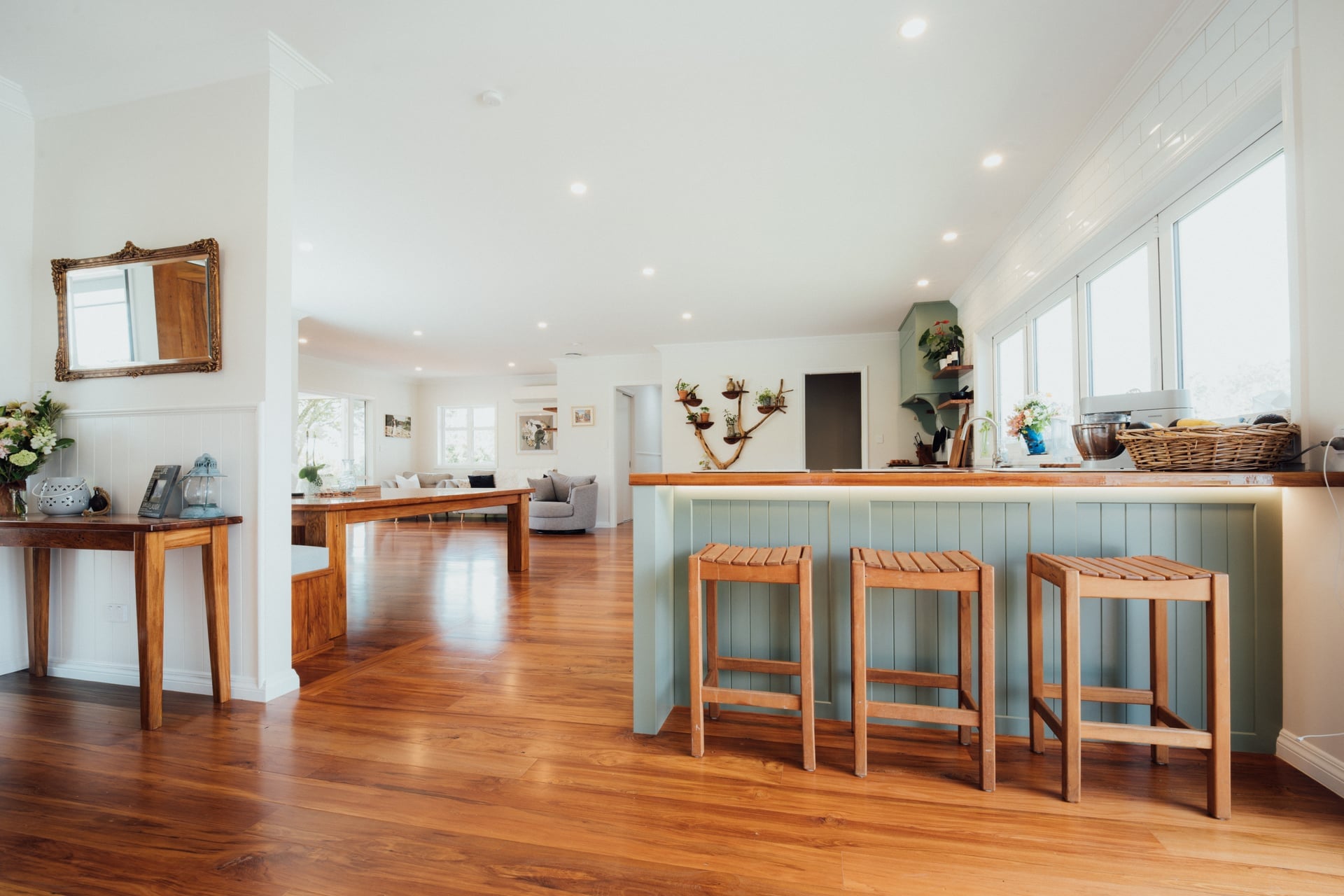
Material selection determines both upfront costs and long-term building performance. Selecting materials below the appropriate standard for your location results in earlier replacement cycles and higher lifetime expenses.
We customise material specifications based on regional environmental factors:
- Coastal Locations (Tauranga & Papamoa): Corrosion resistance is the primary selection criterion for external cladding, joinery, and fixings due to harsh salt air.
- Southern Locations (Christchurch): Exceptional thermal performance and seismic detailing represent the critical factors affecting both project cost and council consenting.
For external cladding, the main options in the New Zealand market include fibre cement, timber or composite weatherboards, brick veneer, and metal panel systems. Each option presents a unique cost profile, maintenance requirement, and weather resistance rating. For high-moisture spaces like kitchens and bathrooms, prioritise waterproofing specifications, cabinetry substrate quality, and high-grade tapware.
We apply the direct material knowledge gained from successfully completed projects such as 2b Ward Street, 129 Maungarangi Road, and our Greerton renovation. On projects in Papamoa and other coastal Tauranga locations, our cladding and joinery specifications are deliberately uprated for salt air exposure. This decision adds a small percentage to the initial material cost but saves homeowners thousands in maintenance over the life of the building.
Why does your choice of builder determine the outcome of your full renovation?
Diack Homes builds and renovates across Tauranga, Papamoa, and Christchurch. Our approach to full home renovations is built around three firm commitments directly addressing the common construction risks outlined in this guide:
- The Gold Standard Guarantee: Our specialised Gold Standard Guarantee is not a standard defects warranty. This protection covers workmanship and materials far beyond minimum legislative requirements. We enforce a documented inspection and sign-off process at each stage of construction. Every project, from the Ridge Road renovation to our Hayes and Leander Street projects, undergoes this identical stage-by-stage check. If the work does not meet our strict standard, we do not move forward.
- 10-Year Master Build Protection: As registered Master Builders, we provide 10-year structural and weathertight protection on qualifying renovation projects. If a covered defect emerges within 10 years of completion, the Master Build guarantee responds. For a homeowner investing $200,000 to $500,000 in a major project, this protection is the most critical security item in the contract.
- BuilderTrend Project Management Software: Every client has real-time access to their project schedule, progress photos, variation approvals, and documentation through the BuilderTrend platform. You do not need to call us to discover what happened on-site today. On our 8 Bayliss Road and 199 Upland Road projects, clients used this platform to track daily progress, approve variations in real time, and preserve a complete project record from day one through handover.
You are able to review our construction standards by exploring our completed projects and reading feedback from past clients on our testimonials page.
Frequently Asked Questions
How do I know whether to renovate or rebuild my home?
The general rule states that when the renovation cost exceeds 60 to 70 per cent of the rebuild cost for a comparable new home, a rebuild often delivers better overall value. The right answer depends on land value, the structural condition of the existing building, and long-term plans for the property. Our FAQs page covers this comparison in more detail, and a site assessment will provide the specific data to evaluate both paths accurately.
Can I stay in the house during a full renovation?
Rarely, and sometimes not safely. Once electrical, plumbing, and structural work begins, large portions of the home are uninhabitable for extended periods. Most full renovation clients in Tauranga and Christchurch arrange alternative accommodation for the main construction phase. Building this cost into your total project budget from the start avoids mid-programme budget pressure.
What insurance do I need when I renovate?
You need contract works insurance to cover the renovation work itself, and your existing home insurance policy must remain active to cover the existing structure during construction. Confirm with your insurer that your policy covers the property while work is underway. Your builder should hold their own public liability and contract works cover, and you should request proof of this before signing any contract.
How do I protect myself against cost overruns during a renovation?
A fixed-price contract with a fully scoped specification is the primary protection against budget blowout. A realistic contingency of 10 to 20 per cent of the contract price handles the unexpected items that arise in most renovations on older homes. Avoiding scope changes during construction is equally important, as variations in the build phase cost significantly more than the same decisions made during the design phase.
What return can I expect on a full home renovation in Tauranga or Christchurch?
In Tauranga and Christchurch markets, a well-specified full renovation on the right property in the right location typically returns between 80 and 120 per cent of the renovation cost in added market value. The return depends on the location, the quality of the work, and market conditions at the time of sale. A pre-renovation valuation is worth commissioning before you finalise your total project budget.
Is a full home renovation the right decision for your property?
A full home renovation represents a significant investment, but for the right property in Tauranga, Papamoa, or Christchurch, this replaces both your living environment and your long-term asset value. The path to a successful outcome runs through thorough planning, an accurate budget with proper contingency, a consented design covering the full scope of work, and a builder with the systems, track record, and guarantees to deliver on promises. The homeowners getting the best results are those who treat the planning phase as seriously as the construction phase, and who choose a builder based on evidence rather than price alone. Both decisions compound through the entire project.
Secure your building project with transparent planning
Starting a full home renovation is a life-changing decision for your family. A successful project requires more than high-quality timber and visual design ideas. Homeowners require a construction partner who prioritises honest communication, detailed pre-construction auditing, and absolute pricing transparency from day one.
Our team is ready to guide you through the complex design, consenting, and building phases to protect your home and your financial investment. We coordinate every detail through our structured systems, ensuring your project remains protected against costly contract variations and unnecessary on-site delays.
Do not leave your renovation outcome to chance. Schedule your initial consultation with Diack Homes today and let us build a plan which is fully scoped, accurately priced, and protected from the first day to handover.